Business Services
Subscribe to our newsletter to receive news, updates, and valuable tips.
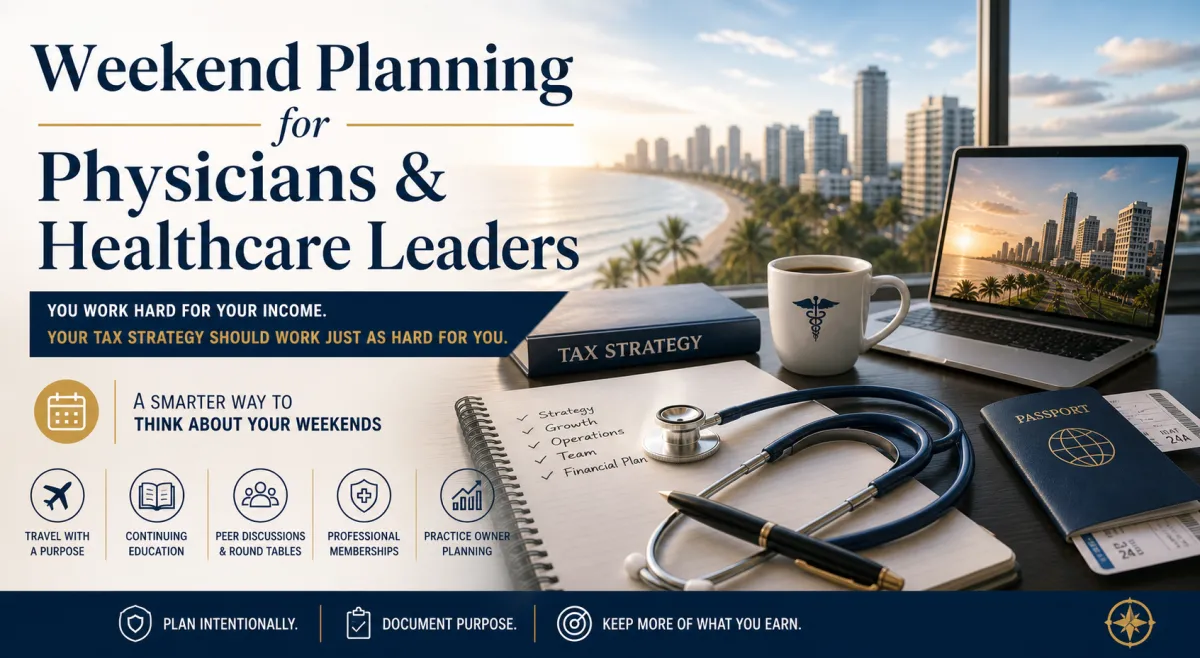
Weekend Planning for Physicians & Healthcare Leaders
You Work Hard for Your Income. Your Tax Strategy Should Work Just as Hard for You.
A Smarter Way to Think About Your Weekends
You spent years in training before you ever earned your full income.
Now you are in practice—managing patients, staff, overhead, and in many cases, a business of your own.
But here’s what many high-earning physicians and specialists overlook:
A meaningful portion of the professional activities already built into your weekends may carry legitimate tax advantages—when planned and structured properly.
This is not about aggressive strategies.
It is about being intentional with what you are already doing.
1. Medical Conferences in Desirable Locations
Major medical associations regularly host conferences in cities like San Diego, New Orleans, Chicago, and Miami.
If you’re attending for:
Continuing medical education (CME)
Clinical updates
Specialty training
Then the associated costs—registration, travel, and qualifying lodging—may be considered professional education expenses.
The location being desirable does not change the treatment.
The primary purpose is what matters.
2. Continuing Education Combined with Travel
Continuing education is not optional in your profession—it is required.
When that education takes place in another city through:
Weekend intensives
Specialty workshops
Accredited seminars
The travel required to attend may be treated as a legitimate business expense.
Many physicians attend multiple programs each year.
Each one is an opportunity to plan with intention.
3. Peer Discussions, Case Reviews, and Clinical Roundtables
Informal peer discussions happen more often than you think:
Case reviews
Treatment planning conversations
Small clinical roundtables
These often take place over a weekend brunch or dinner.
When there is a clear professional purpose, certain expenses—like meals—may qualify.
The activity itself is already happening.
The opportunity lies in how it’s documented.
4. Professional Memberships and Specialty Retreats
Professional memberships are a core part of staying current and connected in medicine.
Annual dues for:
Medical associations
Specialty societies
Clinical networks
are generally considered business expenses.
Additionally, many of these organizations host:
Leadership retreats
Annual gatherings
Educational summits
When these include structured professional content, related expenses may align with business use.
5. Practice Owner Planning Weekends
If you own your practice, you are not just a physician—you are a business owner.
That opens the door to a broader range of strategic opportunities.
A weekend spent:
Reviewing operations
Planning growth
Meeting with advisors or partners
can qualify as a business activity when properly structured.
The key difference?
A written agenda and a clear business purpose.
The Strategy Most Physicians Miss
The physicians who keep more of what they earn are not necessarily working harder.
They are planning earlier.
The difference is not in the activity—
it is in the intent, structure, and documentation behind it.
What Makes It Work
For any of these activities to hold up:
There must be a clear professional or business purpose
The activity must connect to your income or practice
Documentation must support the intent
This includes:
Agendas
Receipts
Notes on attendees and discussions
Proof of participation (CME certificates, registrations, etc.)
Without these, opportunities are often lost.
Final Thought
You are already investing your time.
You are already investing your money.
The real opportunity is aligning those decisions with a strategy that works for you—not against you.
Because tax strategy is not something you do at year-end.
It is something you build into how you live and operate year-round.
Ready to Plan More Intentionally?
If you’re a physician or healthcare professional earning at a high level but still feel like too much is going to taxes…
It may be time to shift from reactive filing to proactive strategy.





Schedule your call today at
(866) 721-5356



ASK QUESTION

SEND A FILE

SUBSCRIBE
Fill out this form and let us know how we can be of service.
We will offer you a complimentary consultation to determine how we can best serve you.





Ready to Keep More of What You Earn?
Start With a Free Tax Savings Assessment
Discover how much you could be saving with proper tax strategy. Our complimentary assessment typically uncovers $15,000-$50,000 in missed deductions and savings opportunities.


Contact Us
(866) 721-5356
100 South Bedford Road, Suite 340, Mt. Kisco, New York 10549
© ADG Accounting Inc.
100 South Bedford Road, Suite 340, Mt. Kisco, New York 10549